I've moved the blog over to here:
http://transcendingmotherhood.com
Thanks for reading!
Sunday, February 15, 2015

Thursday, February 5, 2015
Marshmallows and The Middle Way
Opposites Are Necessary
If you raise your children to be generous,
you must first allow them to be selfish.
If you want them to be disciplined,
you must first allow then to be spontaneous.
If you want them to be hard-working,
you must first allow them to be lazy.
This is a subtle distinction,
and hard to explain to those who criticize you.
A quality cannot be fully learned
without understanding the opposite.
All your friends,
(especially the grandparents)
will tell you this is nonsense.
But look carefully inside of yourself.
Only the child with a strong sense of self
can be truly generous.
Only the child who discovers his or her bliss
will truly work hard.
Most of what passes as discipline and hard work
is an overlay of coerced behavior.
It has no authentic power or joy.
Only the lazy, undisciplined dreamer
can discover within the source of true discipline
that will bring great success.
~The Parent's Tao Te Ching
William Martin

Well, he quickly forgot about the hot chocolate and only wanted the marshmallows.
I, too, wanted the marshmallows - all. the. time. I experienced disappointment after all the excitement of Christmas, and food became a temporary compulsion. We had treats left over from the holidays, and the marshmallows I could grab every time I walked through the kitchen offered a little pick-me-up through the long, gray winter days of being a stay-at-home mother.
Larsen and I encountered the same obstacle: learning "the middle way." It's a Buddhist term that implies balance in life and reminding us to harness awareness with our impulses and behavior.
At the time, I couldn't see that I was depressed that the excitement - of Dad being home more, opening presents, traveling, seeing family, and being caught up in the season - was over. We are in the dark ages again- with no fun holiday in sight.
I couldn't believe the pull the fluffy marshmallows had on me and my son. He would ask for them when he woke, when he had lunch, when he just finished brushing his teeth.
I asked for the marshmallows incessantly too, only realizing later what there was a lesson to be learned here.
The words from Momma Zen echo in my mind daily. Motherhood is something spiritual. It offers an amazing opportunity to draw out your own issues, giving you the time, repetition, and space to reach moments of the higher self.
Her thesis is simple: Look at yourself first.
"You are not raising a mindful child. I am raising a child who is raising my mindfulness."
Maybe Larsen was feeding off of my compulsion. Maybe I was modeling obsession. Maybe I was pursing food for adventure. Maybe a two-year-old can read all of this on his mother's face and her actions and her energy.
Thinking in the zen way of looking within offers more possibility in my approach than thinking this is an opportunity to break Larsen's selfish will of demanding marshmallows.
If I were to assume all children lust for power, then I would need to see how my own lust for power has tainted this view.
We are called to lead them. But maybe the leading them involves much more than dictating from a position of utter authority over another person. Maybe it involves moving out of their way and moving out of our own way, showing them by example how awareness and reason and calm action and empathy solves problems.
For me, the zen path helps me parent from the inside out.
Momma Zen tells me how to do just that:
I must observe the situation and intuit the cause. I must consider her development urges and instincts. I must listen carefully to her words. I must use my own words or silence precisely. I must alter the aggravating situation, ofter by removing her, sometimes by removing me. I must bring all my attention and all my power to correcting what I have done or not done to unwittingly allow, encourage, foster, and fester this mess taking place right now in my own house. And if you argue that this is all too liberal, too permissive, because my daughter must learn what is right and what is wrong, I will respond that in fact my daughter will learn in the same way she learns almost all things - by watching, hearing, and imitating me. My child will do what I do and say what I say, but she will never, without coercion, do what I say. How I wish that every single time she could watch me calm down, cool off, take responsibility, and solve the problem. Only then can she learn to do likewise.But what happens when you realize you are still in a developmental phase as an adult? What happens when you realize you don't have self-control when there are marshmallows involved?
In other words, when we as adults haven't mastered self-discipline, sometimes we must learn alongside our toddler as we slow down and examine our intentions about food, feelings, and freedom.
Maria Montessori reminds us that when a young child is giving freedom, he'll use it to further his development. He actually needs some autonomy in order to reach the next milestone. And I love that Momma Zen also offers up the idea of "developmental urges" that push us toward actualization.
The marshmallow opportunity gave me just what I needed to learn about authentic choice - freedom.
I bought those marshmallows. I put them within my reach. I walked through the kitchen searching for a little perk.
I went from eating a few here and there to the other side of the spectrum and having too many. Grazing then devouring. I was learning about opposites. I was on my way to finding my middle ground.
I needed to have all those Christmas treats and marshmallows haunting me daily. I needed to eat them till my stomach and my soul could register fullness. I needed the opposite to work me back to the middle. I needed my son to watch me practice this so he can master it before he is an adult.
And now that I recognize what is happening, the opening to learn about the full spectrum of choice and then reaching a point of authentic balance, I see it being manifested with Larsen often.
I've seen it when I let him have a box of wipes on his own table, so he could wipe his hands as needed throughout the day. In the beginning, he only wanted to pull the wipes out of the container.
I've seen it when I've put out a container of water and toys to play with and all he wanted to do was dump the water on the floor.
I've seen it when I told him we were finished with breastfeeding, and then he became obsessed with "mommy's milk."
I've seen it when I've let him watch Octonauts on the iPad. He begged for it all the time.
I've seen it with Band-aids. Any small hurt, and off we go to get bandaged.
I am there to help Larsen reach a balance. I give him as much independence as possible within his developmental phase, yet I provide assistance when needed.
The Montessori idea of freedom within limits and her descriptive developmental phases help us to understand what is being worked on with these experiences:
- Sensitive periods
These are critical periods in a child's development between birth and age six that show key sensitivity for the child's attention and exploration of their environment. These unique times of sensitivity help the child acquire certain traits and create a drive for the child's exploration and particular activity. They may overlap but have differing critical periods. Once the special developmental acquisition is fulfilled, or that window of development has passed, the sensitive period disappears. Acquiring traits outside of this sensitive period is not as deep and requires more effort by the brain. The sensitive periods for children between the ages of birth and six years include:- Language
- Order
- Refinement of the senses
- Tactile input
- Movement
- Small details
- Social behavior
- Spatial relationships
- Music
- Reading
- Writing and mathematics
- Normalization and adaptation
Normalization is the process that occurs during the first six years of life (the first plane of development) that allows the child to self-construct through their own purposeful activity which Montessori calls "work". Through activity that is self-chosen and that engages the child's innate capacities and tendencies, effort, repetition and concentration, the process of normalization aid the child to develop:- Self-confidence
- Self-discipline
- Passion and purpose
- Attachment to caring for others in the social community
- A sense of responsibility for care of their environment
- Meaningful contribution
- A general sense of happiness with self and the world around them.
Maybe he's working on refinement of the senses or tactile input when he's pulling out the wipes. According to Montessori, this is the foundation of learning self-control. And once he was allowed the freedom of doing just what he needed - pulling out the wipes - after a two boxes of doing this, me reminding him of the wipe's use, and redirecting his impulse to pull out something from a box (scarves work well for this!), his need was fulfilled. He could now understand balance and move to the next developmental level.
So maybe I need to redirect my impulse to eat marshmallows, starting with an awareness of why I have this need - I was depressed the holidays were gone. I was bored. I needed time to write and read and think, to ingest new ideas (instead of eat).
As an adult, I even needed to shift from one end of the spectrum to another to find my bearings again. I literally had to eat my way to other side for awhile in order to learn my middle path.
If I don't offer him room to play with the extremes, I am actually inhibiting his progress.
The swinging back and forth should be understood as learning or part of the process. To demand our child become proficient at only one side of the issue seems illogical now.
To model self-kindness ("Let's try again tomorrow- no worries") and empathy ("I know it's hard to wait till tomorrow to have our marshmallows again") is part of this zen parenting practice.
Sometimes I have to treat myself as a little child, telling myself these things too, in order to achieve my balance. I need my developmental impulses to be fulfilled so I can move on to a new level of self-discipline as well.
There seems to be a human need for balance that propels us to evolve. As a child - or an adult- we all are working on a developmental sensitivities, finding the middle way that feels authentic to us, finding out how many marshmallows it takes to find our zen.
Wednesday, January 28, 2015
I Celebrate Myself
“I live this way a lot, squinting around the bend, anticipating what I’m about to get. Don’t we keep expecting to get something? In particular, to get it? To figure it out? To reach a culminating resolution, reward, complete understanding, wisdom, clarity, closure, the right answer, the holy grail? That very expectation fills us up and weighs us down.”
~Karen Maezen Miller
It’s as if the entire world has proclaimed us all as insufficient as soon as the ball drops at midnight.
None of these are unimportant intrinsically.
But it is the way we go about getting them which concerns me.
It's like there’s a projection on the wall in front of us we must catch to feel good again after all the failings and insufficiencies we may have experienced in the past year.
We think we will have it all figured out once we get there, like life will begin once we're there, that maybe we will be a better person than before.
Let’s resolve to not start our “new” life from a place of lack.
What you'll see is that your mind is always telling you that you have to change something outside in order to solve your inner problems. But if you are wise, you won't play this game. You'll realize that the advice your mind is giving you is psychologically damaged advice. Of all the advice in the world that you do not want to listen to, it is the advice of a disturbed mind. Your mind actually misleads you. Suppose it tells you, "If I could just get that promotion, then I'd be fine. I'd feel good about myself, and I could get my life together." Have you ever found that to be true? After you get your promotion, does that end all your insecurities and leave you financially satisfied for the rest of your life? Of course not. All that happens is the next problem comes to the surface. Once you see this, you realize the mind has a serious underlying problem. And what it's doing is making up external situations that might make things more comfortable. But the external situations are not the cause of the inner problem....The fact is, however, external changes are not going to solve your problem because they don't address the root of the problem. The root of your problem is that you don't feel whole and complete within yourself. ~Michael A. SingerMaybe there is something supremely substantial in something so uncomplicated.
Maybe I need to just stop pushing myself around the next bend and just keep my head in the present.
I want to replace those yearnings for more with appreciation for less.

I don’t want to set more goals for the future, I want to be at peace today.
I want to grow in satisfaction. If I keep tasting it, if I remind myself of what I already have, that will be enough incentive to keep seeking it instead of lack.
These things are always there. These are the things I should no longer overlook because I am too busy looking beyond.
I want to choose contentment and simply feel the peace I know I deserve (like every single one of us deserves).
I lose more ground with all this mental fumbling around. Not only do I set myself back, it seems like I the finish line is pushed further away. The divide between what is true and what I'd like to be true is widened.
This gap will no longer engulf me.
What we pay attention to thrives.
I CELEBRATE myself, and sing myself,
And what I assume you shall assume,
For every atom belonging to me as good belongs to you.
I loafe and invite my soul,
I lean and loafe at my ease observing a spear of summer grass...
There is that in me — I do not know what it is
— but I know it is in me.
Wrench'd and sweaty — calm and cool then my body becomes,
I sleep — I sleep long.
I do not know it — it is without name — it is a word unsaid,
It is not in any dictionary, utterance, symbol.
Something it swings on more than the earth I swing on,
To it the creation is the friend whose embracing awakes me.
Perhaps I might tell more. Outlines!
I plead for my brothers and sisters.
Do you see O my brothers and sisters?
It is not chaos or death — it is form, union, plan
— it is eternal
life — it is Happiness.
~Walt Whitman
Saturday, January 17, 2015
I Have A Little Faith In Me
Faith is a funny thing.
We bought Lars his own deodorant since he is always playing with Michael’s. I guess he is fascinated with it because it represents something real in the adult world - we slather our bodies with stuff like deodorant, make up, lotions; we talk about how people disappear to a place called “Work” most days; and parents’ jobs include keeping kids safe - which he hears a lot from me lately.
At least the last part I see Larsen is finally understanding, for he has started to make risk evaluations himself.
I think telling kids why it’s important to be safe - “we put the deodorant on our armpits” (or arms for Larzy which he thinks is his armpits) - “please don’t eat the deodorant - it could make your stomach hurt and we would have to go to the hospital if you swallowed it” - “its for keeping us smelling good while we perspire.”
If this seems long winded to be telling a two-year-old, I know! Do you know what kind of patience this takes for a parent? I have to slow down and start telling him reasons before I get annoyed.
Description of the why is very important for kids I think. The whole “Because I said so” line I didn’t understand growing up. I wanted the truth even at age four. And some kids are just like that, and it’s ok.
When we explain the true reason for something to kids, we are showing them some important things like respect, love, critical thinking, and even discipline (our guidance).
I’m always explaining. I’m always telling Larsen about the consequences so he will understand what could happen. I am always telling him it’s my job to keep him safe.
And he’s finally understanding what that means! He gets it on the first time now! He is an amazing kid. They all are.
People would sometimes look at me strangely when I would tell a one-year-old the stove is hot or we need shoes on to keep our feet safe or if we touch a light socket, it could shock us. Maybe people think there is no way a baby could understand these things, but he is always listening. They are always listening.
What’s so satisfying to me about reasoning with a toddler is that the consequences I relate to him are all true. These things are important to know. They build his world. It’s my job as Lars’ parent to introduce him to the world - both the bad and the good, truthfully.
Sometimes I can get heavy with fear, and I will let that fear seep over into Larsen. But fear is scary! I’m terrified now with a child that something bad can happen, or even the idea of his loss (even typing those words feels like a death sentence) overwhelms me more often than not. I have to remember to speak about the good too- that deodorant is a good thing as long as we don’t put it in our mouths, that people do come home from work, that parents keep us safe because they love us and want us to develop these skills on our own too.
Yes, it’s my job to keep him safe. But I can only do so much. I am only a temporary gate keeper.
In his early years, I establish rules for him. But I also establish times where I’m quiet and don’t have rules. I allow for his curiosity and abilities to develop all on his own. I choose to trust in him, to have faith in him.
And with this, there is no idea of shame, of worry, or hopefully “he will learn better next time.” There are just true consequences devoid of my interpreted value on his decisions. There’s no “that’s good or that’s bad,” just “You did X and then Y happened.” Just the facts. He is connecting them all on his own.
At first, it was hard for me to believe that - I mean how many times do I need to repeat myself?! It still is hard to trust he has the ability to make good decisions even at his young age. But he does. And I am utterly astonished.
For me, once I read about how kids do not have a working brain like adults do and their impulse control is severely limited, my frustration of repeating “We put the deodorant on our arms. If we eat it, it could make our stomach ache” subsided and my faith in his abilities flourished.
It takes about 30 days for adults to create new neural pathways, so why do we expect a two-year-old to do it immediately? I think it has taken Lars about three months! Sometimes it does take me telling him about the consequences every single day of each of those months. We've done it with dressing, potty training, and even walking down the street.
His brain is making those neural pathways. It's working even though I might not get immediate results. It takes time for him to process these ideas and to have them imprinted in his brain.
Ah - and what a valuable lesson it is for a toddler to start appreciating: He is responsible for his actions but mom and dad are here to help him navigate too.
There is no hierarchy of knowledge (I'm the omniscient parent), no arrogance from a position of authority (I am superior than you because I know better), no fear about his questioning or doubts (If he questions me, then he is defiant).
So it is through parenthood I have actually come to know more about my spiritual self. I love being a mother to Lars, but I love even more that he is a teacher to me. I love he shows me how to open my heart, even when I want to close it in a protest to fear.
And it’s funny how the connection between parenting and my spiritual self has only begun to unfurl - not only by thinking or meditating on it, not only by praying on it, not only intellectualizing it, not only by reading more about it, but by living out my questions just as Rumi proposed:
I know we each have our own unique journey to faith. I am happy to be living out some of my spiritual questions.
We bought Lars his own deodorant since he is always playing with Michael’s. I guess he is fascinated with it because it represents something real in the adult world - we slather our bodies with stuff like deodorant, make up, lotions; we talk about how people disappear to a place called “Work” most days; and parents’ jobs include keeping kids safe - which he hears a lot from me lately.
At least the last part I see Larsen is finally understanding, for he has started to make risk evaluations himself.
I think telling kids why it’s important to be safe - “we put the deodorant on our armpits” (or arms for Larzy which he thinks is his armpits) - “please don’t eat the deodorant - it could make your stomach hurt and we would have to go to the hospital if you swallowed it” - “its for keeping us smelling good while we perspire.”
If this seems long winded to be telling a two-year-old, I know! Do you know what kind of patience this takes for a parent? I have to slow down and start telling him reasons before I get annoyed.
Description of the why is very important for kids I think. The whole “Because I said so” line I didn’t understand growing up. I wanted the truth even at age four. And some kids are just like that, and it’s ok.
When we explain the true reason for something to kids, we are showing them some important things like respect, love, critical thinking, and even discipline (our guidance).
I’m always explaining. I’m always telling Larsen about the consequences so he will understand what could happen. I am always telling him it’s my job to keep him safe.
And he’s finally understanding what that means! He gets it on the first time now! He is an amazing kid. They all are.
People would sometimes look at me strangely when I would tell a one-year-old the stove is hot or we need shoes on to keep our feet safe or if we touch a light socket, it could shock us. Maybe people think there is no way a baby could understand these things, but he is always listening. They are always listening.
What’s so satisfying to me about reasoning with a toddler is that the consequences I relate to him are all true. These things are important to know. They build his world. It’s my job as Lars’ parent to introduce him to the world - both the bad and the good, truthfully.
Sometimes I can get heavy with fear, and I will let that fear seep over into Larsen. But fear is scary! I’m terrified now with a child that something bad can happen, or even the idea of his loss (even typing those words feels like a death sentence) overwhelms me more often than not. I have to remember to speak about the good too- that deodorant is a good thing as long as we don’t put it in our mouths, that people do come home from work, that parents keep us safe because they love us and want us to develop these skills on our own too.
Yes, it’s my job to keep him safe. But I can only do so much. I am only a temporary gate keeper.
In his early years, I establish rules for him. But I also establish times where I’m quiet and don’t have rules. I allow for his curiosity and abilities to develop all on his own. I choose to trust in him, to have faith in him.
And with this, there is no idea of shame, of worry, or hopefully “he will learn better next time.” There are just true consequences devoid of my interpreted value on his decisions. There’s no “that’s good or that’s bad,” just “You did X and then Y happened.” Just the facts. He is connecting them all on his own.
At first, it was hard for me to believe that - I mean how many times do I need to repeat myself?! It still is hard to trust he has the ability to make good decisions even at his young age. But he does. And I am utterly astonished.
For me, once I read about how kids do not have a working brain like adults do and their impulse control is severely limited, my frustration of repeating “We put the deodorant on our arms. If we eat it, it could make our stomach ache” subsided and my faith in his abilities flourished.
It takes about 30 days for adults to create new neural pathways, so why do we expect a two-year-old to do it immediately? I think it has taken Lars about three months! Sometimes it does take me telling him about the consequences every single day of each of those months. We've done it with dressing, potty training, and even walking down the street.
His brain is making those neural pathways. It's working even though I might not get immediate results. It takes time for him to process these ideas and to have them imprinted in his brain.
Ah - and what a valuable lesson it is for a toddler to start appreciating: He is responsible for his actions but mom and dad are here to help him navigate too.
There is no hierarchy of knowledge (I'm the omniscient parent), no arrogance from a position of authority (I am superior than you because I know better), no fear about his questioning or doubts (If he questions me, then he is defiant).
So it is through parenthood I have actually come to know more about my spiritual self. I love being a mother to Lars, but I love even more that he is a teacher to me. I love he shows me how to open my heart, even when I want to close it in a protest to fear.
And it’s funny how the connection between parenting and my spiritual self has only begun to unfurl - not only by thinking or meditating on it, not only by praying on it, not only intellectualizing it, not only by reading more about it, but by living out my questions just as Rumi proposed:
“...have patience with everything unresolved in your heart and to try to love the questions themselves as if they were locked rooms or books written in a very foreign language. Don’t search for the answers, which could not be given to you now, because you would not be able to live them. And the point is to live everything. Live the questions now. Perhaps then, someday far in the future, you will gradually, without even noticing it, live your way into the answer.”I do wish faith was easier. I want all the answers given to me when I ask the questions. I think that’s what a traditional faith does for some. Sometimes the answer was given before the question was asked.
I know we each have our own unique journey to faith. I am happy to be living out some of my spiritual questions.
I want Lars to know there are good people in the world too. And I want him to be the good in the world as well. So I guess in a sense I'm teaching Lars how to fish instead of giving him a fish.
Through being a parent, I now understand I have to have faith in humanity, not simply God. I have to trust in other people's hearts and abilities.

We are all interconnected, what I do affects others - what they do, affects me. I know that for sure.
I’ve figured out I want a spirituality that connects me with others in a deeper, trusting way. I seek a faith that does exactly what I give to Lars - someone/something to keep me safe but letting me find my own way, empowering me live out the journey without all the made-up reasons like “because I say so."
I have faith in Lars because he is developing on his own with the help of my parenting skills, hope because he will not forever be a child who strives to understand the world and his place in it. I am not limiting his potential because I need him to forever need me.
I’ve only just started developing a trust in others, and it has begun with my son.
Through being a parent, I now understand I have to have faith in humanity, not simply God. I have to trust in other people's hearts and abilities.
We are all interconnected, what I do affects others - what they do, affects me. I know that for sure.
I’ve figured out I want a spirituality that connects me with others in a deeper, trusting way. I seek a faith that does exactly what I give to Lars - someone/something to keep me safe but letting me find my own way, empowering me live out the journey without all the made-up reasons like “because I say so."
I have faith in Lars because he is developing on his own with the help of my parenting skills, hope because he will not forever be a child who strives to understand the world and his place in it. I am not limiting his potential because I need him to forever need me.
I’ve only just started developing a trust in others, and it has begun with my son.
Monday, December 15, 2014
A Mother's Agenda

Throughout the day those dirty dishes haunt me and I have to get over it.
That greasy window - you know that one where your toddler has smeared hot dog and fingerprints and snot- haunts me. The stack of unpaid bills that sit by the computer haunts me. The planning of the next meal haunts me. The sad dogs that desperately miss their morning sniffs around the neighbor's mailboxes haunt me. And I have to get over it.
My advice to new parents: Embrace the spiral.
Your agenda now happens in spurts throughout the day (or maybe even the week). Your linear mind will ultimately adjust to the curling, winding, and twisting parenthood requires.
And it's all going to be ok.
You don't have to measure yourself by clean dishes, sparkling windows, completed tasks, or worn-out puppy dogs.
All you have to do is be present with your kids.
That's your most important item of the day.
If you're running through to-do lists while you play blocks with your baby, your mind is elsewhere. And the baby knows.
And you know. And you probably feel awful about it.
But that aching pull to make things clean and shiny and prefect again ties knots in your gut and competes with your attention like another child, jealous of your affection to the baby.
And sometimes when you're not expecting it to, your little guru, your toddler, shows you a new way. It's halts you in your tracks, and the hauntings relinquish for a while.
For new parents, the key is to keep these moments of glorious pause stringed together all throughout the day - getting your fix filled, training your mind to replace those yearnings of productivity with a craving to play kitchen with your toddler.
It does get easier my friends. Those ghosts soften and fly away. You will find a way to do what needs to be done and still look in your child's eyes as you authentically say for the eightieth time that day, "Yes, you did build the tower high! I see."
Along the path to parenthood enlightenment, you will be close to finishing the dishes which somehow makes your soul feel good, but you will be halted by baby cries or toddler's pleas to play with him with only three more dirty pans to go.
The days you rush to get a toddler dressed so you can make it to gymnastics on time and you just say F-it while you grab his pants and shoes and throw them in your purse, knowing he will want to get dressed once we get there, will pass. The whole fighting to not get back in that car seat will pass....eventually.
You will exhaust your creative energy on finding ways to cajole him into wanting the things you want, doing the things you want to do when you want to do them. (Sounds a lot like jail time for your toddler, doesn't it?)
All you have to do is be present with your kids.
Those leisurely morning walks in the stroller as preparation for nap time will change into beseeching a little child who wants to run instead of sit. Those moments will turn out to be more waiting for you, sitting on the stairwell, explaining to the dogs why you are holding three leashes but you aren’t going anywhere yet.
Your mind will soon understand how to keep things organized when there’s a tornado in the house - have less stuff.
When every day becomes rush, rush, rush - just whisper your mantra about presence. Your mind will shout, "If you could just get him to sleep, you could scramble like a crazy person to get things accomplished." But don't let that voice overcome your new simple plan.
Luckily, the morale you need to accomplish your new agenda will be sitting in front of you, wearing Planes underwear and an applesauce stained shirt.
During another block building session, he will show you a better agenda, instead of the anxiety, frustration, and hinderances you seem to grab a hold of so tightly.
He will place his little warm hand on your cheek to literally turn your head from the mental check list to look at him. He will plant a tender kiss on your lips.
You will be stunned. You will pause, take a deep breath, and notice how very fortunate you are to have a zen guru as a son.
You will realize the only thing that matters is being present with him.
You have a healthy little boy to love you, a companion on this journey with you, and a limited amount of time to enjoy it all.
You will eventually learn that your old, mark-things-off-the-list self has to evolve into honoring this new, less-orderly life of not always doing. You may no longer get to feel successful at being productive.
It may take a year, and I mean every single, count-down-till-bedtime day to let your heart be at peace with your agenda being altered.
And everyday may still be a challenge to find the right balance of tidiness and sanity, mindfulness and productivity, selfishness and devotion, but thankfully, if we are paying attention, our children will help us find our way.
Monday, September 8, 2014
For Larsen on Your Second Birthday

Today, like most days, you were in and out of closets, drawers, and toy baskets, but mostly you were in and out of my memory. You pulled out gloves, hats, toys, books, and on my heart strings. I sit back dazed, thinking how will I ever clean this up and also how will I make it through your birthday tomorrow with this aching deep within my chest. You're two! You're two.....
I knew this was coming for me as I always live in the future. I try to stay in the present, but it's the planning for the upcoming pain that holds me back.
And I know what's coming when it comes to you: separation.
You're running, and talking, and doing, and being - all a little more without me for the first time in both of our lives.
And right now all I can think about is the sentimentality of it all.
I have to remind myself you're not mine to keep. Before, I just snuggled, held, rocked, and soothed you for a good part of the day. Now, I get reminded of the widening simply by your newfound distance.
If your family lineage gives you anything, I sincerely hope you inherit a strident independence. Actually, I know you already have. I see it in the way you grab your new golf club and walk outside - determined to hit that ball, and how you can hang with Daddad without giving me another glance after we say bye, and how you run twenty feet in front of me instead of beside me.
It's not that your growing autonomy hurts my heart. It's just that my optimism for your freedom is tied to sadness, but also with joy. It's the job of untangling of it all I have to welcome now. It's a mess in there, and I have to rearrange it all so I don't hold you back.
I understand you need me less. I know parents slowly get used to it, just as we have when we started leaving you with sitters. At first, our worry costed us our happiness when we were away from you. But then we learned to accept the distance and actually welcome it.
I'm sure this happens the same way as you grow into an adult - bite sized chunks of freedom here and there to help me prepare for those big partings.
But did the last year have to be so hard to swallow? It was a year of firsts! First birthdays, first steps, first words, first glimpses of you becoming you. And they have all unfolded before me as glorious moments to savor with no time to worry because something else was always there behind it to again delight me. But now- you're two. You're second birthday is aptly named - it just took a second and we're here. Before we know it, I am truly holding you for the last time as we dance at your wedding.
I know, I know - I'm jumping ahead of myself, again preparing. Hopefully, with time, your gaining independence with not be anchored in my soul with such sadness.
But it's true. I'm sad. Even our joyous memories are mixed in with sorrow that they've passed.
Our days together will forever be in my heart. But right now they feel heavy. Yet, I trust they will lighten into joy.
"Time will tell me what I can't hear now," Patty Griffin's song reminds me.
I will take those moments of bouncing frog on the sheet, of running out the front door to catch a glimse of the trash truck, of rubbing your little round toes as I hold you close. I'll cherish those days of hearing,"Momma, Momma, Come!" and "Okay" for the rest of my life.
And maybe that's what I'm afraid of - all these tender, fleeing moments are just that- here for a second, eluding my grasp, toying with my soul, wondering if I will long for these days again for the rest of my life? Are these our best days together, Larzy?
Why can't I enjoy them today instead of preparing to miss them tomorrow?
As I compose myself for your birthday tomorrow, I want to be free from this burden. I want to hold you, and dance with you, and not wonder if today is one of the last times I get to be your universe.
As I think of your second birthday and how time elapsed quicker these two years than the rest of my life, I will make time and my mind shut up and be still.
I will breathe in the little bit of baby smell you still have, and it will still be a wonder. I will let you grow, and I will release this intense desire to hold you forever and just let you be.
I'm learning too, Larsen. Just like the closet and drawers you were playing in today, you pull out these emotions from me, throwing them all over. You've made me think about these jumbled feelings - being anxious and gladdened.
But in particular, you've made me realize I have to embrace the joy within the sadness. I have to find ways to reorganize myself, deciding what serves me and what doesn't, what helps you grow and what doesn't.
And while I am constantly worried I won't have enough time to put things back in their place before you're on to the next thing, I am deliriously happy - I am your mother. I am a proud, rejoicing mother of a two-year-old.
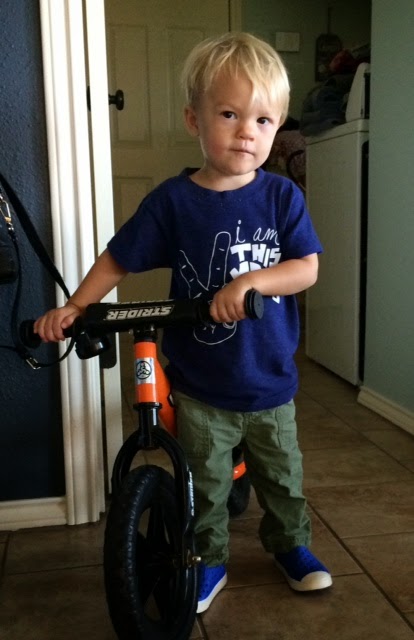
Sunday, June 15, 2014
In the Image of God
When I was a child, a preacher used a metaphor about a cake pan to describe human beings. Adam was the original cake pan. After the "great fall," the cake pan was dented. So as decedents of Adam, we are all now non-perfect cakes. We are somehow hollow, reduced.
But I simply don't believe it. I will not pass that myth to my child. He's perfect in every way, just as we all are.
The child's face that I look in to is not a sinner. He's not a broken individual waiting to be healed. He's not evil, looking for someone to fix his fractured self.
He is, however, a child of God - of any God (you'll read what I mean shortly), a child of mystery, a person of fullness.
I know there are many ways to look at the belief of broken humanity, but I continually think about the psychological damage we do to children when we keep pushing the "sinner" theology and thus set the foundation for this cycle of brokenness to continue.
I sincerely think we do damage to children when we call them broken, bad, or selfish. They internalize those terms, and it becomes a self-fulfilling prophecy of negative attitudes. Maybe this is one reason this study found extremely religious states have more crime, divorce, and defeatist attitudes.
According to Psychology Today, labeling people has intense effects, whether negative or positive:
In no way I am trying to trample on people's most sacred beliefs - those things we all hold in our hearts and feel connected to in our core.
But I am trying to make sense of this in my head.
I know many deeply religious friends whose foundation is built on Christ's love, Gandhi's patience, or Mother Theresa's giving.
However, my mind is caught where I know it's detrimental labeling someone "bad" from the get go.
Maybe we just don't see it that way when religious dialog shrouds the core belief because we aren't allowed to question these fundamental beliefs - which we may not even pay attention to anymore anyway. Maybe if we do wonder beyond them, it may mean we aren't as faithful as we are told we should be.
Perhaps describing humanity as sinners is so much part of the script we have been handed we don't recognize the power it holds over our children, and in a larger sense, the world we are creating and living in today.
I recently read Just Babies: The Origins of Good and Evil. I love the title because it has a play on the word "just" as in "morally right, fair," and also as in "simply" - we are simply babies until our environment molds us.
The author's belief is that babies are born with a moral sense:
-psychologists have found that children naturally help adults without prompting:
I think sometimes we label children's behavior according to our limited internal script- and if that limited internal script bases actions on the precept of a broken, deficient human - what do we expect to see? And once more, what are we truly encoding onto our children? Broken people continue to break. Yet, people who see themselves as helpers or do-gooders continually help or do good.
As a parent, I think about messages that surround us. I want my child to learn about Jesus, but also Mary Magdalena, Mother Teresa, Buddha, Gandhi, and more. I want him to feel and recognize the perfection of all of these regular humans too - who, we must remind ourselves- were created in God's image. And while all these people were just humans, they all successfully made their arrows sharp and hit the mark (using the Greek definition of sin here, meaning "to miss the mark" like an arrow missing the target) and thus have exercised their perfection! Yes, to keep reinforcing the good brings forth more good.
So I want to throw out this lexicon of "sinner, reborn, rebellious, missing the mark" - I don't want there to always be this struggle involving a dented cake and failure, a sense of deficiency and unfulfillment.
Maybe we forgot or simply never realized we don't have to use this idea of lack to make us want more. Maybe we need to remember success begets success, goodness begets more goodness, fullness begets more fullness.
We are utterly God-like. We do have the capacity to make the world better - here today we do have creative control- and it's as accessible as the words we choose to sculpt the world we live in.
"For we are God's handiwork, created in Christ Jesus to do good works, which God prepared us in advance for us to do." ~Ephesians 2:10
But I simply don't believe it. I will not pass that myth to my child. He's perfect in every way, just as we all are.
The child's face that I look in to is not a sinner. He's not a broken individual waiting to be healed. He's not evil, looking for someone to fix his fractured self.
He is, however, a child of God - of any God (you'll read what I mean shortly), a child of mystery, a person of fullness.
I know there are many ways to look at the belief of broken humanity, but I continually think about the psychological damage we do to children when we keep pushing the "sinner" theology and thus set the foundation for this cycle of brokenness to continue.
I sincerely think we do damage to children when we call them broken, bad, or selfish. They internalize those terms, and it becomes a self-fulfilling prophecy of negative attitudes. Maybe this is one reason this study found extremely religious states have more crime, divorce, and defeatist attitudes.
According to Psychology Today, labeling people has intense effects, whether negative or positive:
The long-term consequences of labeling a child like Hannah "smart" or "slow" are profound. In another classic study, Robert Rosenthal and Lenore Jacobson told teachers at an elementary school that some of their students had scored in the top 20% of a test designed to identify "academic bloomers"--students who were expected to enter a period of intense intellectual development over the following year. In fact, the students were selected randomly, and they performed no differently from their unselected peers on a genuine academic test. A year after convincing the teachers that some of their students were due to bloom, Rosenthal and Jacobson returned to the school and administered the same test. The results were astonishing among the younger children: the "bloomers," who were no different from their peers a year ago, now outperformed their unselected peers by 10-15 IQ points. The teachers fostered the intellectual development of the "bloomers," producing a self-fulfilling prophecy in which the students who were baselessly expected to bloom actually outperformed their peers.So, when I read studies like this, I simply wonder why we would label first our selves as a sinner and then do the same to our children? Wouldn't the world be better if we enforce the good?
In no way I am trying to trample on people's most sacred beliefs - those things we all hold in our hearts and feel connected to in our core.
But I am trying to make sense of this in my head.
I know many deeply religious friends whose foundation is built on Christ's love, Gandhi's patience, or Mother Theresa's giving.
However, my mind is caught where I know it's detrimental labeling someone "bad" from the get go.
Maybe we just don't see it that way when religious dialog shrouds the core belief because we aren't allowed to question these fundamental beliefs - which we may not even pay attention to anymore anyway. Maybe if we do wonder beyond them, it may mean we aren't as faithful as we are told we should be.
Perhaps describing humanity as sinners is so much part of the script we have been handed we don't recognize the power it holds over our children, and in a larger sense, the world we are creating and living in today.
I recently read Just Babies: The Origins of Good and Evil. I love the title because it has a play on the word "just" as in "morally right, fair," and also as in "simply" - we are simply babies until our environment molds us.
The author's belief is that babies are born with a moral sense:
"This is not the same as an impulse to do good and avoid doing evil. Rather, it is the capacity to make certain types of judgements - to distinguish between good and bad, kindness and cruelty. What's most vital to understand here is the profound effect we have on their morality. What we express, they imitate."There are some more lines that have stayed with me after reading which highlight children's natural "moral sense":
-psychologists have found that children naturally help adults without prompting:
"Maybe their helping is an adaptive behavior designed to endear them to their caretakers, analogous to their physical charms such as big eyes and round cheeks. But researchers have evidence that suggests that helping- at least by older children - really is motivated by a genuine care for others."-babies do not have the ability of doing good or bad things themselves just yet:
"babies are sensitive to the good and bad acts of others long before they are capable of doing anything good or bad themselves. It seems likely, then, that the 'moral sense' is first extended to others and then at some later point in development turns inward."In an interview, the author continues to explain what his book is all about, succinctly answering questions I had about humans:
Q)So are babies naturally good, or naturally evil?
A) Both! We are born with empathy and compassion, the capacity to judge the actions of others, and a rudimentary understanding of justice and fairness. Morality is bred in the bone. But there is a nastier side to our natures as well. There’s a lot of evidence that even the youngest babies carve the world into Us versus Them—and they are strongly biased to favor the Us. We are very tribal beings. Our natures are not just kind; they are also cruel and selfish. We favor those who look like us and are naturally cold-blooded towards strangers.
Q) Does this mean that prejudice and racism are inevitable?
A) Happily, no. For one thing, social experience really matters—babies and children have to learn who Us versus Them is by observing how those around them act. So while some distinctions are inevitable, such as friends versus strangers, others are not. Notably, it is only pretty late in development—by about the age of five—that some children come to use skin color and similar cues when decide who to befriend and who to prefer. Before this, they don’t know that race matters, and so whether or not children will be racist is dependent on how they are raised; what sort of social environments they find themselves in. Also, we are smart critters, smart enough to override our impulses and biases when we think they are inappropriate. Once we learn about these ugly aspects of our nature, we can move to combat them. We can create treaties and international organizations aimed at protecting universal human rights. We can employ procedures such as blind reviewing and blind auditions that are designed to prevent judges from being biased, consciously or unconsciously, by a candidate’s race—or anything other than what is under evaluation.
Q) It seems as if a lot of your interest is in how we come to transcend our hard-wired morality.
A) That’s right. A complete theory of morality has to have two parts. It starts with what we are born with, and this is surprisingly rich. But a critical part of our morality—so much of what makes us human—is not the product of evolution, but emerges over the course of human history and individual development. It is the product of our compassion, our imagination, and our magnificent capacity for reason. We bring all that to bear when we consider such questions as: How much should we give to charity? Is it right to eat meat? Are there any sorts of consensual sex acts that are morally wrong?
Q) What do you want to accomplish with this book?
A) Two things. First, many people believe that we are born selfish and amoral—that we start off as natural-born psychopaths. And many argue that we are, as David Hume put it, slaves of the passions: our moral judgments and moral actions are the product of neural mechanisms that we have no awareness of and no conscious control over. Intelligence and wisdom are largely impotent. This is an ugly view of human nature. Now, if it were true, we should buck up and learn to leave with it. But it’s not true; these dismissive claims are refuted by everyday experience, by history, and by the science of developmental psychology. We are moral animals, and we are powerfully influenced by our capacity for reason. Second, I think there are practical implications to the scientific study of morality. If you’re interested in reducing racism and bigotry, for instance, it is critical to understand our inborn proclivity to favor our own group over others; if you want to create a just society, you’ll want to learn about how we naturally think about fairness and equity. Good social policy is informed by an understanding of human nature at its best and its worst, and this is what Just Babies is all about.
So much of evil we think is fixed in humans seems to be malleable- and that's truly good news. We do have innate qualities that warrant our concern. But again- I think that's what the book is saying- we can be optimistic that due to "our compassion, our imagination, and our magnificent capacity for reason" we have the power to redirect these lower impulses (if that's even a good way to describe them) and focus on the good, the perfected God-like in all of us.
I think sometimes we label children's behavior according to our limited internal script- and if that limited internal script bases actions on the precept of a broken, deficient human - what do we expect to see? And once more, what are we truly encoding onto our children? Broken people continue to break. Yet, people who see themselves as helpers or do-gooders continually help or do good.
As a parent, I think about messages that surround us. I want my child to learn about Jesus, but also Mary Magdalena, Mother Teresa, Buddha, Gandhi, and more. I want him to feel and recognize the perfection of all of these regular humans too - who, we must remind ourselves- were created in God's image. And while all these people were just humans, they all successfully made their arrows sharp and hit the mark (using the Greek definition of sin here, meaning "to miss the mark" like an arrow missing the target) and thus have exercised their perfection! Yes, to keep reinforcing the good brings forth more good.
So I want to throw out this lexicon of "sinner, reborn, rebellious, missing the mark" - I don't want there to always be this struggle involving a dented cake and failure, a sense of deficiency and unfulfillment.
Maybe we forgot or simply never realized we don't have to use this idea of lack to make us want more. Maybe we need to remember success begets success, goodness begets more goodness, fullness begets more fullness.
We are utterly God-like. We do have the capacity to make the world better - here today we do have creative control- and it's as accessible as the words we choose to sculpt the world we live in.
"For we are God's handiwork, created in Christ Jesus to do good works, which God prepared us in advance for us to do." ~Ephesians 2:10
Subscribe to:
Posts (Atom)